Oridonin (98%) Ultimativer Leitfaden (2026): Struktur, natürliche Quellen, Forschungsanwendungen, Qualitätsstandards & Einkaufsratgeber
Aug 27, 2026
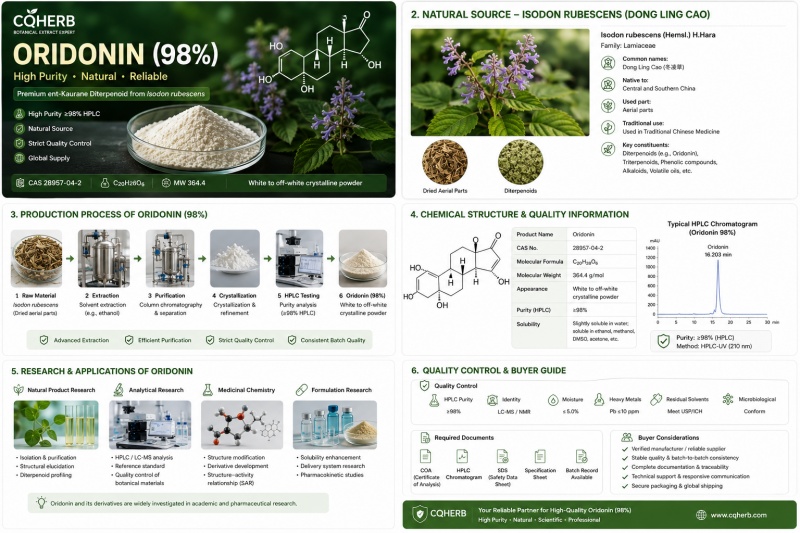
Oridonin (98%) Ultimativer LeitfadenEin technischer Leitfaden zu Struktur, natürlichen Rohstoffen, Forschung, Produktion, Qualitätskontrolle und LieferantenauswahlOridonin Es handelt sich um ein natürlich vorkommendes Diterpenoid, das hauptsächlich aus Isodon rubescens isoliert wird, einer Pflanze, die in China traditionell als Dong Ling Cao bekannt ist. Aufgrund seines charakteristischen Molekülgerüsts vom ent-Kauran-Typ, seiner vielfältigen Naturstoffchemie und der umfangreichen Forschung in den Bereichen Molekularbiologie, Pharmakologie, pharmazeutische Chemie und Wirkstoffforschung hat es erhebliches wissenschaftliches Interesse geweckt.Für Hersteller und Forschungseinrichtungen reicht es jedoch nicht aus, die beschriebenen biologischen Aktivitäten von Oridonin zu betrachten, um es vollständig zu verstehen. Die Qualität eines kommerziellen Oridonin-Präparats hängt von seiner botanischen Quelle, dem Extraktions- und Reinigungsverfahren, der Analysemethodik, den Reinheitsvorgaben, der Chargenkonsistenz und der zugehörigen technischen Dokumentation ab.Dieser Leitfaden bietet einen forschungsorientierten Überblick über Oridonin, mit besonderem Augenmerk auf hochreines 98%iges Oridonin, einschließlich seiner chemischen Identität, natürlichen Quelle, physikalisch-chemischen Eigenschaften, Produktionsüberlegungen, analytischer Qualitätskontrolle, Forschungsanwendungen und praktischer Lieferantenbewertung. KurzantwortWas ist Oridonin?Oridonin ist ein natürlich vorkommendes Diterpenoid vom ent-Kauran-Typ, das hauptsächlich in Isodon rubescens, einem Mitglied der Familie der Lippenblütler (Lamiaceae), vorkommt. Seine CAS-Nummer lautet 28957-04-2, die Summenformel C₂₀H₂₈O₆ und die molare Masse beträgt etwa 364,4 g/mol.Oridonin ist eines der am besten untersuchten Diterpenoide aus Isodon rubescens. Moderne Forschungen haben seine molekularen Wechselwirkungen, zellulären Signalwege, pharmakokinetischen Eigenschaften, Strukturmodifikationen und potenziellen Anwendungen in der Naturstoff- und Arzneimittelforschung untersucht.Aus kommerzieller Sicht unterscheidet sich hochreines Oridonin von einem herkömmlichen Extrakt aus Isodon rubescens oder Dong Ling Cao. Ein standardisierter Pflanzenextrakt enthält zahlreiche natürlich vorkommende Bestandteile, wohingegen 98%iges Oridonin eine gereinigte Einzelverbindung mit definierter Molekülstruktur und deutlich engeren analytischen Spezifikationen darstellt.Durch diese Unterscheidung ist hochreines Oridonin besonders relevant für Labore und Hersteller, die reproduzierbare Forschungsmaterialien, eine definierte chemische Zusammensetzung und eine quantitative analytische Kontrolle benötigen.Für Käufer sollte die Bewertung der Oridonin-Qualität daher über die angegebene Reinheit hinausgehen. Wichtige Kriterien sind die HPLC-Methodik, das chromatographische Profil, die Identitätsbestätigung, Restlösungsmittel, Schwermetalle, Feuchtigkeit, Lagerbedingungen, Chargenkonsistenz und die Fähigkeit des Lieferanten, eine vollständige technische Dokumentation bereitzustellen. Wichtigste ErkenntnisseOridonin ist ein natürlich vorkommendes Diterpenoid, das hauptsächlich mit Isodon rubescens in Verbindung gebracht wird.CAS 28957-04-2 ist die allgemein anerkannte CAS-Kennung für Oridonin.Seine Summenformel lautet C20H28O6, mit einer molaren Masse von ungefähr 364,4 g/mol.Kew's Plants of the World Online akzeptiert derzeit Isodon rubescens als Artnamen, während Rabdosia rubescens als Synonym behandelt wird.Oridonin gehört zur Familie der ent-Kauran-Diterpene.Isodon rubescens enthält zahlreiche Diterpenoide und andere sekundäre Metaboliten, wobei Oridonin zu den am besten untersuchten Bestandteilen zählt.Hochreines Oridonin und Isodon rubescens-Extrakt sind nicht austauschbar.Die HPLC ist ein wichtiges analytisches Werkzeug zur Bewertung der Reinheit von Oridonin und der Qualität von aus Isodon rubescens gewonnenen Materialien.Die Forschung zu Oridonin umfasst Naturstoffchemie, molekulare Mechanismen, Pharmakokinetik, Strukturmodifikation und Studien zur Wirkstoffentwicklung.Die relativ geringe Wasserlöslichkeit und Bioverfügbarkeit stellen weiterhin wichtige Aspekte in der pharmazeutischen Forschung dar.Bei der B2B-Beschaffung sollte die Reinheit zusammen mit der Identität, der Analysemethodik, der Dokumentation und der Chargenkonsistenz bewertet werden. InhaltsverzeichnisWas ist Oridonin?Warum ist Oridonin wissenschaftlich wichtig?Chemische Struktur und Eigenschaften von OridoninNatürliche Quelle: Isodon rubescensOridonin vs. Isodon rubescens-ExtraktWie wird hochreines Oridonin hergestellt?Oridonin-Qualitätsstandards und HPLC-AnalyseÜberlegungen zur Löslichkeit und Stabilität von OridoninForschungsanwendungen von OridoninOridoninderivate und StrukturmodifikationWie man einen zuverlässigen Oridonin-Lieferanten auswähltCheckliste für Käufer von Oridonin 98%Häufig gestellte FragenCQHERB Technischer EinblickWissenschaftliche Referenzen 1. Was ist Oridonin?Oridonin ist ein natürlich vorkommendes Diterpenoid, das hauptsächlich in Isodon rubescens vorkommt. Es gehört zu einer strukturell vielfältigen Familie pflanzlicher Diterpene und wird als Diterpenoid vom ent-Kauran-Typ charakterisiert.Die Verbindung wurde aufgrund ihres charakteristischen polyzyklischen Molekülgerüsts und ihrer zahlreichen sauerstoffhaltigen funktionellen Gruppen eingehend untersucht. Diese Strukturmerkmale machen Oridonin zu einem wichtigen Forschungsobjekt in der Naturstoff- und Medizinchemie.Der anerkannte botanische Name lautet derzeit Isodon rubescens (Hemsl.) H.Hara, wie von den Royal Botanic Gardens, Kew, angegeben. Rabdosia rubescens wird von Kew als Synonym geführt. Beide Namen tauchen daher häufig in wissenschaftlichen Publikationen und in der kommerziellen Literatur auf.DefinitionOridonin ist ein natürlich vorkommendes ent-Kauran-Diterpenoid mit der Summenformel C20H28O6 und CAS 28957-04-2, das hauptsächlich aus Isodon rubescens isoliert wurde. 2. Warum ist Oridonin wissenschaftlich wichtig?Oridonin hat aus mehreren Gründen anhaltende wissenschaftliche Aufmerksamkeit auf sich gezogen.Erstens stellt es ein strukturell einzigartiges Naturstoffgerüst dar. Zweitens kann es als chemisch definierte Verbindung isoliert und gereinigt werden, wodurch Forscher seine molekularen Eigenschaften unabhängig von den vielen anderen in der Pflanze vorkommenden Bestandteilen untersuchen können.Drittens wurde Oridonin in umfangreichen Forschungsarbeiten im zellulären, biochemischen, pharmakokinetischen und medizinisch-chemischen Kontext untersucht. Übersichtsartikel der letzten Jahre fassen die Forschungsergebnisse zu Signalwegen, Zellzyklusregulation, Apoptose, Autophagie, oxidativen Prozessen und anderen molekularen Phänomenen zusammen.Wichtig ist, dass sich ein Großteil dieser Literatur auf präklinische oder experimentelle Forschung bezieht. Ergebnisse aus Zellmodellen oder Tierstudien sollten nicht automatisch als Beleg für eine etablierte klinische Wirksamkeit beim Menschen interpretiert werden.Diese Unterscheidung ist besonders wichtig, wenn Oridonin auf einer kommerziellen Website präsentiert wird. Warum ist hochreines Oridonin wichtig?Die Reproduzierbarkeit von Forschungsergebnissen wird stark von der Materialkonsistenz beeinflusst.Ein roher Pflanzenextrakt kann zahlreiche Verbindungen enthalten, deren Konzentrationen je nach folgenden Faktoren variieren:Pflanzlichen UrsprungsSorte oder genetischer HintergrundWachstumsbedingungenErntezeitraumExtraktionsmethodeVerarbeitungsbedingungenLagerungEin gereinigtes Oridonin-Material reduziert viele dieser Variablen, indem es eine definierte Zielverbindung bereitstellt.Für Labor- und Formulierungsentwicklungsarbeiten bietet hochreines Oridonin daher folgende Vorteile:Definierte chemische IdentitätStandardisierte ReinheitBessere ChargenkonsistenzBesser reproduzierbare AnalyseergebnisseLeichterer Vergleich zwischen ExperimentenPräzisere Formulierungsberechnungen Zeitleiste der wissenschaftlichen ForschungForschungsphaseAllgemeine EntwicklungFrühe NaturstoffforschungIsolierung und strukturelle Charakterisierung von OridoninSpätere phytochemische ForschungErweiterung der Forschung zu Isodon-DiterpenoidenModerne analytische ForschungVerbesserte HPLC- und LC-MS-CharakterisierungÄra der MolekularforschungZunehmende Erforschung zellulärer und SignalmechanismenAktuelle ForschungStrukturmodifikation, Verabreichungssysteme, Pharmakokinetik und Studien zur WirkstoffforschungDie kontinuierliche Weiterentwicklung analytischer und biochemischer Technologien hat es Forschern ermöglicht, Oridonin auf immer detaillierterer molekularer Ebene zu untersuchen.AbschnittszusammenfassungOridonin ist nicht nur deshalb von wissenschaftlicher Bedeutung, weil es aus einer traditionellen Heilpflanze stammt, sondern weil es eine besondere Naturproduktstruktur mit umfangreicher experimenteller Forschung und der Möglichkeit, als definierte Verbindung isoliert zu werden, verbindet. 3. Chemische Struktur und physikalisch-chemische Eigenschaften von OridoninGrundlegende chemische InformationenEigentumInformationGebräuchlicher NameOridoninCAS-Nummer28957-04-2MolekularformelC20H28O6Molekulargewicht364,4 g/molChemische Klasseent-Kauran-DiterpenoidNatürliche QuelleIsodon rubescensTypische Spezifikation für hohe Reinheit≥98 % (HPLC)Die molekulare Identität und die grundlegenden chemischen Informationen stimmen mit dem PubChem-Eintrag für Oridonin überein. Was macht die Oridonin-Struktur interessant?Oridonin besitzt ein komplexes tetracyclisches Diterpenoidgerüst mit mehreren oxygenierten funktionellen Gruppen und einem Enon-verwandten Strukturmotiv.Diese Kombination struktureller Merkmale trägt zur Bedeutung der Verbindung in der medizinisch-chemischen Forschung bei.Forscher haben das Oridonin-Grundgerüst auch als Ausgangspunkt für chemische Modifikationen genutzt. Verschiedene Derivate wurden untersucht, um Eigenschaften wie Löslichkeit, Stabilität, Pharmakokinetik und biologische Aktivität zu verändern. SchlüsseldefinitionenDiterpenoidEin Naturprodukt, das im Allgemeinen aus vier Isopreneinheiten gewonnen wird und 20 Kohlenstoffatome enthält.ent-Kauran-DiterpenoidEine Strukturklasse der Diterpenoide, die sich durch ein spezifisches tetrazyklisches Kohlenstoffgerüst auszeichnet.HPLCHochleistungsflüssigkeitschromatographie (HPLC) ist eine Analysetechnik, die häufig zur Trennung, Identifizierung und Quantifizierung von Komponenten in einer Probe eingesetzt wird.ReinheitDer Anteil der Zielverbindung im Verhältnis zu anderen nachweisbaren Komponenten unter Anwendung einer definierten Analysemethode. AbschnittszusammenfassungDie definierte Summenformel und die charakteristische ent-Kauran-Diterpenoidstruktur von Oridonin machen es für detaillierte analytische und medizinisch-chemische Untersuchungen geeignet. Sein Strukturgerüst dient zudem als nützlicher Ausgangspunkt für die Untersuchung chemisch modifizierter Derivate. 4. Natürliche Quelle: Isodon rubescensWelche Pflanze produziert Oridonin?Die wichtigste natürliche Quelle für Oridonin ist Isodon rubescens (Hemsl.) H.Hara, eine Art aus der Familie der Lippenblütler (Lamiaceae). Kew verwendet derzeit Isodon rubescens als den korrekten Namen und führt Rabdosia rubescens als Synonym.Die Art ist in Zentral- und Südchina heimisch.Die Pflanze ist im chinesischen Kontext allgemein als Dong Ling Cao (冬凌草) bekannt, und die getrockneten oberirdischen Teile werden seit langem in der traditionellen chinesischen Medizin verwendet. Phytochemische Komplexität von Isodon rubescensWichtig für Käufer ist, dass Isodon rubescens keine Pflanze ist, die ausschließlich Oridonin produziert.Wissenschaftliche Untersuchungen haben eine große Anzahl von Sekundärmetaboliten der Art dokumentiert, darunter:DiterpenoideTriterpenoidePhenolische VerbindungenAlkaloideFlüchtige BestandteileAndere spezialisierte MetabolitenUnter diesen Bestandteilen stellen die Diterpenoide eine der am besten untersuchten Gruppen dar, wobei Oridonin eine der bekanntesten Verbindungen ist. Warum die botanische Herkunft wichtig istDie Konzentration einzelner Verbindungen in einem pflanzlichen Rohstoff kann je nach folgenden Faktoren variieren:PflanzengenetikGeografischer UrsprungAnbaubedingungenErntezeitPflanzenteilTrocknungsbedingungenExtraktionstechnologieUntersuchungen an Rabdosia rubescens haben außerdem gezeigt, dass der Gehalt an verschiedenen Verbindungen zwischen unterschiedlichen Sorten variieren kann, was die Bedeutung der analytischen Qualitätskontrolle unterstreicht.AbschnittszusammenfassungIsodon rubescens ist die wichtigste botanische Quelle für Oridonin. Da die Pflanze ein komplexes Gemisch aus Diterpenoiden und anderen sekundären Pflanzenstoffen enthält, erfordert die Gewinnung von hochreinem Oridonin eine spezielle Extraktion und Reinigung anstelle einer einfachen botanischen Extraktion. 5. Oridonin vs. Isodon rubescens-ExtraktDiese Unterscheidung ist insbesondere für internationale Käufer wichtig.BesonderheitOridonin 98%Isodon rubescens-ExtraktProdukttypGereinigte EinzelverbindungMehrkomponenten-PflanzenextraktHauptzielOridoninMehrere PflanzeninhaltsstoffeReinheitsspezifikationTypischerweise wird der Oridonin-Gehalt mittels HPLC angegeben.Kann Extraktverhältnis oder Marker-Verbindungsspezifikation verwendenChemische ZusammensetzungEng definiertKomplexReproduzierbarkeit von ForschungsergebnissenHoch, wenn die Analysemethode kontrolliert wirdAbhängig von der ExtraktspezifikationTypische VerwendungForschung, Analytik und FormulierungsentwicklungForschung und Formulierung von pflanzlichen InhaltsstoffenQualitätskontrolleHPLC, Identität, Verunreinigungen und weitere SpezifikationenMarkerstoffe, Extraktionsverhältnis, Verunreinigungen und weitere SpezifikationenKäufertippWenn für ein Projekt eine bestimmte Konzentration an Oridonin benötigt wird, ist der Kauf eines standardisierten, hochreinen Oridonin-Materials in der Regel unkomplizierter als die Verwendung eines herkömmlichen Isodon rubescens-Extrakts.Wenn für das Projekt speziell das breitere phytochemische Profil der Pflanze benötigt wird, ist ein standardisierter Pflanzenextrakt möglicherweise besser geeignet.AbschnittszusammenfassungOridonin 98 % und Isodon rubescens-Extrakt sollten nicht als gleichwertige Produkte betrachtet werden. Ersteres ist eine gereinigte Verbindung, letzteres ein komplexes pflanzliches Präparat mit mehreren Bestandteilen. 6. Wie wird hochreines Oridonin hergestellt?Vom pflanzlichen Rohmaterial zur gereinigten VerbindungDie Herstellung von hochreinem Oridonin erfordert mehrere Stufen, da die Zielverbindung in der Pflanze zusammen mit zahlreichen anderen Bestandteilen vorkommt.Ein vereinfachtes Produktionskonzept lautet:Botanisches Rohmaterial↓Extraktion↓Filtration / Konzentration↓Fraktionierung↓Reinigung↓Kristallisation oder weitere Verfeinerung↓Trocknung↓HPLC-Test↓Hochreines OridoninDer genaue Prozess hängt von der Technologie des Herstellers, den Spezifikationen der Rohstoffe, der angestrebten Reinheit, dem Maßstab und den analytischen Anforderungen ab. ExtraktionDas erste Ziel ist die Überführung von Oridonin und verwandten Bestandteilen aus der Pflanzenmatrix in einen geeigneten Extrakt.Die Extraktionsparameter können Folgendes beeinflussen:ErtragVerunreinigungsprofilLösungsmittelverbrauchAnforderungen an die nachgelagerte Reinigung ReinigungRohextrakte enthalten viele natürlich vorkommende Verbindungen.Um eine hohe Oridonin-Spezifikation zu erreichen, ist daher eine selektive Trennung von folgenden Bestandteilen erforderlich:Andere DiterpenoidePigmentePhenolische BestandteileLipophile KomponentenAndere pflanzliche VerunreinigungenVeröffentlichte Forschungsergebnisse haben den Einsatz chromatographischer Technologien wie der Hochgeschwindigkeits-Gegenstromchromatographie zur Isolierung und Reinigung von Oridonin aus Isodon rubescens gezeigt. HPLC-VerifizierungNach der Reinigung wird mittels analytischer Tests überprüft, ob das Material die geforderten Spezifikationen erfüllt.Die HPLC kann Informationen liefern über:Aufbewahrungszeit ZielspitzeRelative ReinheitChromatographisches ProfilMögliche VerunreinigungenDarüber hinaus wurden in der Forschung HPLC-basierte Methoden zur gleichzeitigen Charakterisierung und Quantifizierung mehrerer Verbindungen in Rabdosia rubescens entwickelt, was die Bedeutung der chromatographischen Analyse für die Qualitätskontrolle unterstreicht. CQHERB Technischer EinblickBei hochreinen pflanzlichen Monomeren besteht die Herausforderung in der Herstellung nicht einfach darin, „mehr Substanz zu extrahieren“. Die zentrale Herausforderung liegt vielmehr darin, eine selektive Reinigung bei gleichzeitiger Aufrechterhaltung einer reproduzierbaren analytischen Qualität zu erreichen.Deshalb sollte ein professioneller Lieferant nicht nur die endgültige Reinheit, sondern auch die zur Überprüfung dieser Spezifikation verwendete Analysemethode erläutern können. 7. Oridonin-Qualitätsstandards und HPLC-AnalyseSind 98 % Reinheit ausreichend?Nicht unbedingt.Eine Angabe zur Reinheit von 98 % ist zwar nützlich, sollte aber immer im Zusammenhang mit der Analysemethode und den beigefügten Unterlagen interpretiert werden.Bei der Bewertung eines Oridonin-98%-Materials sollten Käufer Folgendes beachten:1. HPLC-ReinheitBestätigen Sie, wie der Wert von 98 % ermittelt wurde.Mögliche Fragen sind beispielsweise:Welche HPLC-Methode wurde verwendet?Ist die Methode klar beschrieben?Ist das Chromatogramm verfügbar?Wird die Reinheit durch Flächennormalisierung oder mit einer anderen Methode berechnet?2. IdentitätDer Lieferant sollte nachweisen können, dass es sich bei der getesteten Verbindung um Oridonin und nicht um ein anderes Diterpenoid mit ähnlichem chromatographischem Verhalten handelt.3. Chromatographisches ProfilEin Chromatogramm kann nützliche Informationen liefern über:HauptgipfelAufbewahrungszeitSekundäre PeaksGesamtprobenprofil4. RestlösungsmittelWerden bei der Herstellung organische Lösungsmittel verwendet, kann je nach beabsichtigter Anwendung und geltenden Normen eine Restlösungsmittelprüfung angebracht sein.5. Schwermetalle und SchadstoffeBei Materialien pflanzlichen Ursprungs können Käufer auch Informationen anfordern zu:FührenCadmiumArsenQuecksilberMikrobiologische Parameter Empfohlene technische DokumenteBei internationalen B2B-Beschaffungen sollte ein professioneller Lieferant gegebenenfalls Folgendes bereitstellen können:Analysezertifikat (COA)ProduktspezifikationHPLC-ChromatogrammSicherheitsdatenblatt / SicherheitsdatenblattTechnisches DatenblattInformationen zu RestlösungsmittelnInformationen zu SchwermetallenVerpackungsinformationenLagerungsempfehlungen 8. Überlegungen zur Löslichkeit und Stabilität von OridoninDie Löslichkeit ist ein wichtiger technischer Aspekt bei der Arbeit mit Oridonin.Veröffentlichte Forschungsergebnisse haben die relativ geringe Wasserlöslichkeit und Bioverfügbarkeit als wichtige Herausforderungen bei der Entwicklung von Oridonin-basierten Arzneimittelformulierungen identifiziert. Forscher haben Ansätze wie Strukturmodifikationen, Formulierungstechnologien, Nanopartikel, Liposomen und Kokristalle untersucht, um diese Einschränkungen zu überwinden.Für Forscher und Entwickler von Formulierungen bedeutet dies, dass Oridonin nicht nur nach seiner chemischen Reinheit bewertet werden sollte.Zu den praktischen Überlegungen gehören:LösungsmittelauswahlKonzentrationTemperaturLagerbedingungenLichtexpositionContainerkompatibilitätFormulierungsmatrix Warum die Löslichkeit in der Forschung eine Rolle spieltZwei Proben mit identischer HPLC-Reinheit können sich in einer praktischen Formulierung unterschiedlich verhalten, wenn:Die Partikelgröße ist unterschiedlichDie Probenvorbereitung unterscheidet sichLösungsmittelsysteme unterscheiden sichDie Speicherhistorie ist unterschiedlichDie experimentelle Temperatur variiertDaher sollten Forschungsprotokolle die Bedingungen der Probenvorbereitung klar dokumentieren, wenn Oridonin in lösungsbasierten Experimenten verwendet wird.AbschnittszusammenfassungDie physikochemischen Eigenschaften von Oridonin, insbesondere seine begrenzte Wasserlöslichkeit, sind wichtige Aspekte für die Forschung und Formulierungsentwicklung. Eine hohe chemische Reinheit garantiert nicht automatisch eine einfache Formulierung oder hohe Bioverfügbarkeit. 9. Forschungsanwendungen von OridoninOridonin wurde in verschiedenen Bereichen der wissenschaftlichen Forschung untersucht.NaturstoffchemieForscher untersuchen Oridonin als repräsentatives ent-Kauran-Diterpenoid und als eine Komponente der komplexen Phytochemie von Isodon rubescens.Forschungsthemen umfassen:IsolierungStrukturelle AufklärungDerivatisierungAnalytische CharakterisierungNaturstoffbiosynthese Molekular- und ZellforschungEine große Anzahl experimenteller Studien hat Oridonin im Zusammenhang mit zellulären Prozessen untersucht, wie zum Beispiel:ApoptoseAutophagieZellzyklusregulationOxidativer StressEntzündungssignaleZellstoffwechselDiese Ergebnisse basieren überwiegend auf Labor- und präklinischen Modellen und sollten nicht als Beweis für eine klinische Wirksamkeit interpretiert werden.Aktuelle Studien untersuchen weiterhin die vorgeschlagenen molekularen Mechanismen von Oridonin und seine Interaktion mit verschiedenen Signalwegen. Forschung in der pharmazeutischen ChemieOridonin hat sich auch als nützliches Ausgangsgerüst für die medizinisch-chemische Forschung erwiesen.Forscher haben strukturelle Modifikationen untersucht, die darauf abzielen, Herausforderungen wie die folgenden zu bewältigen:Schlechte WasserlöslichkeitBegrenzte BioverfügbarkeitSchnelle FreigabePharmakokinetische EinschränkungenOridoninderivate haben sich daher zu einem eigenen Forschungsgebiet innerhalb der Naturstoff-Arzneimittelforschung entwickelt. Analytische ForschungDa Oridonin eine definierte chemische Verbindung ist, kann es auch verwendet werden in:HPLC-MethodenentwicklungLC-MS-AnalyseReferenzmaterialforschungBotanische QualitätskontrollstudienVergleichende phytochemische Analyse Wichtiger ForschungshinweisDie in der wissenschaftlichen Literatur beschriebenen biologischen Aktivitäten bedeuten nicht, dass Oridonin 98%, das als Forschungsbestandteil verkauft wird, ein zugelassenes Arzneimittel ist oder dass es zur Diagnose, Behandlung, Heilung oder Vorbeugung von Krankheiten bestimmt ist.Forschungsergebnisse sollten stets im Hinblick auf das experimentelle Modell, die Konzentration, die Formulierung und das Studiendesign interpretiert werden. 10. Oridonin-Derivate und StrukturmodifikationEin besonders interessanter Aspekt der Oridonin-Forschung ist die Entwicklung chemisch modifizierter Derivate.Das natürliche Oridonin-Grundgerüst diente als Ausgangspunkt für die Untersuchung von Veränderungen an funktionellen Gruppen und Molekülregionen, die folgende Auswirkungen haben könnten:LöslichkeitStabilitätZielinteraktionPharmakokinetikBiologische AktivitätIn Übersichtsartikeln zu Oridonin-Derivaten wurde umfangreiche medizinisch-chemische Forschung dokumentiert, die darauf abzielte, die Eigenschaften der Ausgangsverbindung zu verbessern.Diese Forschung demonstriert ein wichtiges Prinzip der Naturstoffchemie:Eine natürliche Verbindung kann nicht nur selbst als Forschungsmaterial dienen, sondern auch als Strukturvorlage für die Entwicklung neuer chemischer Verbindungen.AbschnittszusammenfassungOridonin stößt weiterhin auf Interesse, sowohl als Naturstoff als auch als chemisches Grundgerüst. Die Forschung an seinen Derivaten verdeutlicht die Schnittstelle zwischen Pflanzenchemie, medizinischer Chemie und moderner Wirkstoffforschung. 11. Wie man einen zuverlässigen Oridonin-Lieferanten auswähltFür B2B-Käufer sollte die Auswahl eines Oridonin-Lieferanten mehr beinhalten als nur einen Preisvergleich.1. Produktidentität bestätigenÜberprüfen:CAS-NummerChemischer NameMolekularformelMolekulargewichtHPLC-Profil2. Reinheitsprüfung bestätigenErkundigen Sie sich, wie die 98%-Spezifikation ermittelt wird, und fordern Sie die entsprechenden analytischen Unterlagen an.3. Chargendokumentation prüfenEin aktuelles Chargen-Analysezertifikat ist nützlicher als ein allgemeines Datenblatt.4. Fertigungskapazität bewertenPrüfen Sie, ob der Lieferant:Stellt das Material herKontrolliert die ReinigungFührt analytische Tests durchFührt Chargenprotokolle5. Technischen Support bewertenBei Inhaltsstoffen für Forschungszwecke kann die technische Kommunikation genauso wichtig sein wie der Preis.Ein zuverlässiger Lieferant sollte Fragen beantworten können überReinheitHPLCLöslichkeitLagerungVerpackungLieferzeitDokumentation 12. Checkliste für Käufer von Oridonin 98%Vor der Bestellung können Käufer die folgende Checkliste verwenden.Bestätigen Sie CAS 28957-04-2Bestätigung der Summenformel C20H28O6Molekulargewicht bestätigenBestätigen Sie die HPLC-Spezifikation von ≥98 %.Aktuelle Charge des COA anfordernHPLC-Chromatogramm anfordernMethode zur IdentitätsprüfungInformationen zu Restlösungsmitteln prüfenInformationen zu Schwermetallen überprüfenVerpackung bestätigenLagerbedingungen bestätigenVerfügbarkeit von Mustern bestätigenProduktionsvorlaufzeit bestätigenTechnische Dokumentation bestätigenBewertung der langfristigen Lieferfähigkeit 13. Häufig gestellte FragenWas ist Oridonin?Oridonin ist ein natürlich vorkommendes ent-Kauran-Diterpenoid, das hauptsächlich in Isodon rubescens vorkommt. Seine CAS-Nummer lautet 28957-04-2.Was ist die CAS-Nummer von Oridonin?Die allgemein anerkannte CAS-Nummer lautet 28957-04-2.Wie lautet die Molekularformel von Oridonin?Die Summenformel lautet C20H28O6.Wie hoch ist das Molekulargewicht von Oridonin?Das Molekulargewicht beträgt ungefähr 364,4 g/mol.Aus welcher Pflanze wird Oridonin gewonnen?Oridonin wird hauptsächlich mit Isodon rubescens, einer Art aus der Familie der Lippenblütler (Lamiaceae), in Verbindung gebracht. Rabdosia rubescens ist ein anerkanntes Synonym.Ist Oridonin dasselbe wie Dong Ling Cao-Extrakt?Nein. Dong Ling Cao oder Isodon rubescens-Extrakt ist ein komplexes Pflanzenpräparat, während Oridonin eine gereinigte Einzelverbindung ist.Was bedeutet 98% Oridonin?Dies deutet im Allgemeinen darauf hin, dass Oridonin gemäß der angegebenen Analysemethode, üblicherweise HPLC, mindestens 98 % des Materials ausmacht. Die Analysemethode sollte stets zusammen mit der angegebenen Reinheit überprüft werden.Wie wird die Reinheit von Oridonin geprüft?Die HPLC wird häufig für die quantitative Analyse und Reinheitsprüfung eingesetzt. Je nach Anwendung können zusätzliche Techniken wie LC-MS oder NMR zur Identitätsbestimmung verwendet werden.Ist Oridonin wasserlöslich?Oridonin weist eine begrenzte Wasserlöslichkeit auf, was als wichtige technische Herausforderung in der pharmazeutischen Formulierungsforschung identifiziert wurde.Wozu wird Oridonin verwendet?Hochreines Oridonin ist vor allem für die wissenschaftliche Forschung, die Naturstoffchemie, analytische Studien, die pharmazeutische Chemie und die Formulierungsentwicklungsforschung relevant.Ist Oridonin ein zugelassenes Medikament?Die Forschung an Oridonin und Oridoninderivaten wird fortgesetzt, aber ein Oridonin-Wirkstoff in Forschungsqualität sollte nicht als zugelassenes Arzneimittel bezeichnet werden, nur weil pharmakologische Studien veröffentlicht wurden.Worin besteht der Unterschied zwischen Oridonin und anderen Isodon-Diterpenoiden?Isodon rubescens enthält zahlreiche Diterpenoide. Oridonin ist eine spezifische Verbindung mit eigener chemischer Identität, Summenformel und eigenem analytischen Profil.Kann Oridonin als analytisches Referenzmaterial verwendet werden?Hochreines Oridonin kann für die analytische Forschung relevant sein, seine Eignung als formaler Referenzstandard hängt jedoch von der erforderlichen Zertifizierung, der Reinheitscharakterisierung, der beabsichtigten Analysemethode und den anwendbaren Normen ab.Warum ist HPLC für Oridonin wichtig?Die HPLC bietet eine praktische Möglichkeit, Oridonin zu trennen und zu quantifizieren sowie das chromatographische Profil einer Probe zu beurteilen.Welche Dokumente sollte ein Oridonin-Lieferant vorlegen?Typische Dokumente umfassen Analysezertifikate (CoA), Datenblätter, HPLC-Chromatogramme, Sicherheitsdatenblätter (SDS/MSDS) und technische Daten. Weitere Dokumente hängen von der Anwendung des Kunden und den regulatorischen Anforderungen ab.Wie sollte Oridonin gelagert werden?Die Lagerungsempfehlungen sollten den validierten Spezifikationen und Stabilitätsdaten des Lieferanten entsprechen. Generell ist es ratsam, unnötige Einwirkung von Hitze, Feuchtigkeit und Licht auf gereinigte Naturprodukte zu vermeiden.Können Oridonin-Derivate synthetisiert werden?Ja. Zahlreiche Forschungsprogramme haben die Strukturmodifikation von Oridonin untersucht, um Veränderungen der physikochemischen und biologischen Eigenschaften zu erforschen.Warum erforschen Wissenschaftler Oridonin-Derivate?Ein wichtiger Grund ist die Untersuchung, ob durch Strukturmodifikation Einschränkungen der Ausgangsverbindung, wie z. B. Löslichkeit und pharmakokinetische Eigenschaften, behoben werden können.Worauf sollten Käufer vor dem Kauf von Oridonin 98% achten?Zu den wichtigsten Kriterien gehören Identität, HPLC-Reinheit, Chromatogramm, Analysezertifikat, Produktionsquelle, Analysemethode, Verunreinigungen, Lagerbedingungen und Lieferantenkonsistenz.Ist Oridonin 98% dasselbe wie ein 98%iger Isodon rubescens-Extrakt?Nein. „98% Oridonin“ beschreibt eine Spezifikation für eine gereinigte Verbindung, während „98% Isodon rubescens Extrakt“ ein ganz anderes Produktkonzept beschreibt und nicht davon ausgegangen werden sollte, dass es die gleiche chemische Zusammensetzung aufweist. 14. Technischer Einblick in CQHERBReinheit ist nur ein Aspekt der Qualität botanischer MonomereBei hochreinen pflanzlichen Verbindungen wie Oridonin ist es verlockend, Lieferanten ausschließlich anhand der auf dem Analysezertifikat (COA) abgedruckten Zahl zu bewerten.Professionelle Beschaffung erfordert jedoch eine umfassendere Sichtweise.Eine fundierte Qualitätsbewertung sollte Folgendes berücksichtigen:IdentitätHandelt es sich bei dem Material tatsächlich um Oridonin?ReinheitEntspricht das Material der angegebenen Spezifikation von ≥98 %?Analytische MethodeWie wurde die Reinheit bestimmt?Chromatographisches ProfilZeigt das HPLC-Chromatogramm ein sauberes und konsistentes Profil?SchadstoffkontrolleWerden Restlösungsmittel, Schwermetalle, Feuchtigkeit und mikrobiologische Parameter angemessen kontrolliert?ChargenkonsistenzKann der Lieferant dieselbe Spezifikation wiederholt liefern?RückverfolgbarkeitLässt sich das Material auf einen definierten Herstellungs- und Prüfprozess zurückführen?Dieser Ansatz ist besonders wichtig, wenn Oridonin in Forschungsprojekten eingesetzt wird, bei denen die Reproduzierbarkeit wichtiger ist als der niedrigste Kaufpreis. 15. BrancheneinblickeDie Entwicklung von Oridonin spiegelt einen breiteren Trend in der pflanzlichen Inhaltsstoffindustrie wider: den Übergang von komplexen traditionellen Extrakten hin zu gut charakterisierten natürlichen Verbindungen.Forscher und Hersteller fordern zunehmend:Definierte molekulare IdentitätStandardisierte ReinheitZuverlässige AnalysedatenGleichbleibende ChargenqualitätTransparente technische DokumentationGleichzeitig eröffnen Fortschritte in der Naturstoffchemie neue Möglichkeiten, pflanzliche Verbindungen als molekulare Gerüste und nicht nur als traditionelle Kräuterextrakte zu untersuchen.Oridonin ist ein besonders gutes Beispiel für diesen Übergang, da sich die Forschung von der einfachen Isolierung und Charakterisierung auf molekulare Mechanismen, Pharmakokinetik, Strukturmodifikation, Verabreichungstechnologien und die Entwicklung von Derivaten ausgeweitet hat. Warum wir diesen Leitfaden veröffentlicht habenZiel dieses Leitfadens ist es nicht, Oridonin durch unbegründete Wirksamkeitsbehauptungen zu bewerben.Stattdessen zielt CQHERB darauf ab, Forschern, Herstellern und Einkäufern eine praktische technische Referenz zum Verständnis zu bieten:Was ist Oridonin?Woher es kommtWie es sich von Pflanzenextrakten unterscheidetWie hochreine Materialien bewertet werdenWarum HPLC wichtig istWelche technischen Herausforderungen sollten Forscher berücksichtigen?Wie man Lieferanten bewertetBei pflanzlichen Inhaltsstoffen sind verlässliche Informationen ein wesentlicher Bestandteil der Produktqualität. Abschließende ZusammenfassungOridonin ist ein strukturell einzigartiges ent-Kauran-Diterpenoid, das hauptsächlich in Isodon rubescens vorkommt. Mit der Summenformel C₂₀H₂₈O₆ und der CAS-Nummer 28957-04-2 zählt es zu den am besten untersuchten Diterpenoiden dieser Pflanzenart.Die moderne Forschung reicht von der Isolierung und Strukturaufklärung von Naturstoffen bis hin zu Molekularbiologie, Pharmakokinetik, Formulierungsforschung und der Entwicklung von Oridonin-Derivaten. Gleichzeitig untersuchen Forscher weiterhin Herausforderungen wie die begrenzte Wasserlöslichkeit und Bioverfügbarkeit.Für B2B-Käufer ist entscheidend, dass es sich bei 98%igem Oridonin um eine gereinigte Einzelverbindung und nicht um einen herkömmlichen Isodon rubescens-Extrakt handelt. Die Qualität sollte daher anhand einer Kombination aus Reinheit, Identität, HPLC-Profil, Kontaminationskontrolle, Dokumentation und Chargenkonsistenz bewertet werden.Da das wissenschaftliche Interesse an standardisierten Naturstoffen stetig wächst, stellt Oridonin ein wichtiges Beispiel dafür dar, wie traditionelle botanische Ressourcen zu gut charakterisierten Materialien für die moderne Naturstoff- und pharmazeutische Forschung werden können. Suchen Sie einen zuverlässigen Oridonin-Lieferanten?Wenn Sie hochreines Oridonin (98%) für Forschungszwecke, analytische Entwicklung, Formulierungsstudien oder die langfristige B2B-Lieferung beziehen, sollten die technischen Spezifikationen entsprechend Ihrer beabsichtigten Anwendung bewertet werden.CQHERB kann Produktinformationen und technische Dokumentationen zur Bewertung bereitstellen, darunter:COAProduktspezifikationHPLC-ChromatogrammSicherheitsdatenblatt/SicherheitsdatenblattTechnische DatenBeispielunterstützungVerpackungsinformationenTechnische Informationen anfordern Wissenschaftliche ReferenzenPubChem. Oridonin – CID 5321010. National Center for Biotechnology Information.Königliche Botanische Gärten, Kew. Pflanzen der Welt Online: Isodon rubescens (Hemsl.) H.Hara.Royal Botanic Gardens, Kew. Rabdosia rubescens (Hemsl.) H.Hara – Synonym von Isodon rubescens.Ali MA, et al. Oridonin aus Rabdosia rubescens: Ein neues Potenzial in der Krebstherapie – Eine umfassende Übersicht. Food Science & Nutrition. 2024.Zhang Y, Wang S, Dai M, et al. Verbesserung der Löslichkeit und Bioverfügbarkeit von Oridonin: Eine Übersicht. Molecules. 2020;25(2):332.Oridonin: Eine Übersicht zu Pharmakologie, Pharmakokinetik und Toxizität. PubMed-indexierte Übersicht.Sobral PJM, Vicente ATS, Salvador JAR. Aktuelle Fortschritte bei Oridoninderivaten mit Antikrebsaktivität. Frontiers in Chemistry. 2023.Das Naturprodukt Oridonin als Antikrebsmittel: Aktuelle Erfolge und Probleme. PubMed-indexierte Übersichtsarbeit. 2023.Isolierung und Reinigung von Oridonin aus der gesamten Pflanze Isodon rubescens mittels Hochgeschwindigkeits-Gegenstromchromatographie.Gleichzeitige Charakterisierung und Quantifizierung von 17 Hauptbestandteilen in Rabdosia rubescens mittels Hochleistungsflüssigkeitschromatographie. PubMed.Aktuelle Fortschritte bei den molekularen Mechanismen der durch das Naturprodukt Oridonin und seine Derivate induzierten Apoptose. Übersichtsarbeit 2026.Antikrebsmechanismen der durch Oridonin induzierten Pyroptose: Neue potenzielle zielgerichtete Therapiestrategien. Biomedicine & Pharmacotherapy. 2023. Verbesserung der Bioverfügbarkeit und Einblick in den Wirkmechanismus schwerlöslicher Naturstoffe durch die Herstellung von Co-Kristallen: Oridonin als Beispiel. Phytomedicine. 2024.Entdeckung und Entwicklung von Oridonin-inspirierten Naturstoff-Antikrebsmitteln. PubMed-indexierte Übersichtsarbeit.Forschungsfortschritte und molekularer Mechanismus von Oridonin bei der Behandlung des malignen Melanoms. Übersichtsarbeit 2025. InhaltsklassifizierungInhaltstyp: Ultimativer Leitfaden / Pillar PageWissensdatenbank-Kategorie: Wissensdatenbank für PflanzenextraktePrimäre Suchabsicht: Informations- und WirtschaftsrechercheZielgruppe: Forscher, Formulierer, Hersteller, Einkäufer und RohstoffkäuferEmpfohlener Inhaltsbereich:Oridonin Ultimativer Leitfaden↓Was ist Oridonin?↓Chemische Struktur von Oridonin↓Oridonin Löslichkeit & Stabilität↓Oridonin HPLC & COA Leitfaden↓Oridonin-Extraktion und -Reinigung↓Oridonin vs. Isodon rubescens-Extrakt↓Wie man einen Oridonin-Lieferanten auswählt↓Oridonin FAQ Hub Wichtiger redaktioneller HinweisDieser Artikel unterscheidet bewusst zwischen wissenschaftlichen Forschungsergebnissen und etablierten klinischen oder kommerziellen Aussagen. Oridonin wurde zwar umfassend in experimentellen Systemen untersucht, doch sollten veröffentlichte präklinische Ergebnisse nicht als Beweis für die therapeutische Wirksamkeit beim Menschen herangezogen werden. Diese Vorgehensweise trägt dazu bei, den professionellen, forschungsorientierten Charakter der CQHERB-Wissensdatenbank zu wahren und unnötige regulatorische und werbetechnische Risiken zu minimieren.
MEHR LESEN
 Deutsch






 IPv6-Netzwerk unterstützt